
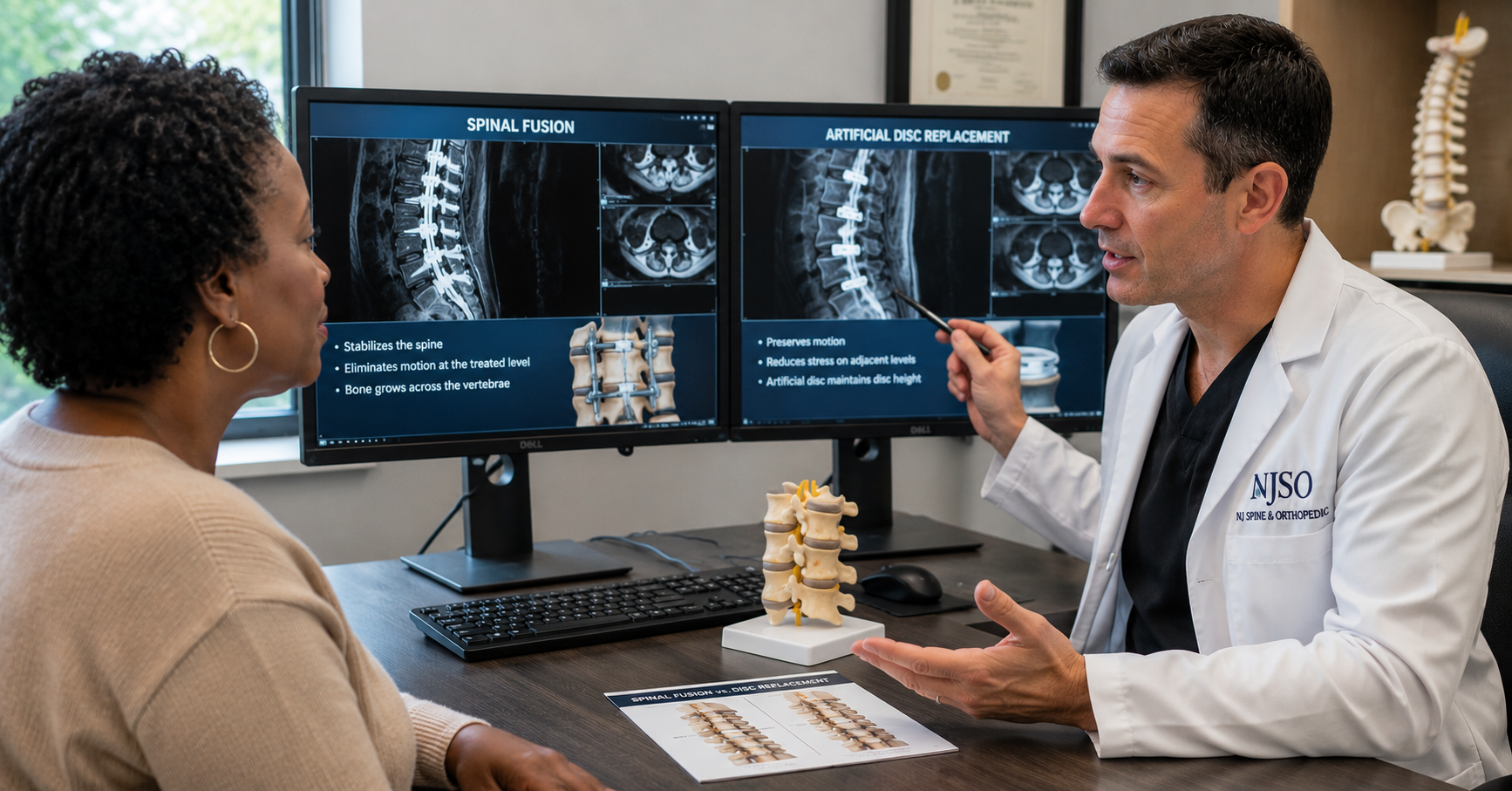
Patients comparing disc replacement vs spinal fusion are often trying to answer the same question: which procedure is more likely to eliminate pain without creating new limitations afterward? Both disc replacement and spinal surgeries treat spinal conditions involving damaged discs, nerve compression, or instability, but they work differently and are not intended for the same type of patient. Both procedures have similar success rates for reducing pain in properly selected patients.
Understanding how each procedure works, who qualifies, and how recovery differs makes it easier to evaluate treatment options realistically.
Introduction to Spine Conditions
Spine conditions such as degenerative disc disease can have a profound effect on daily life, often causing chronic pain, stiffness, and reduced mobility. Degenerative disc disease happens when the discs between vertebrae break down, losing their ability to cushion the spine and support normal movement.. This degeneration can lead to discomfort, nerve irritation, and even changes in posture. Other common spine conditions, including spinal deformities and herniated discs, may also contribute to pain and functional limitations. Recognizing the signs of these conditions and understanding their impact is crucial for maintaining spine health and seeking appropriate treatment options.
Surgical Options for Spine Conditions
When conservative treatments are no longer effective, surgical options like spinal fusion and disc replacement can help alleviate pain and restore function for patients with degenerative disc disease, spinal deformities, or other spine-related issues. Spinal fusion surgery involves removing the damaged disc and permanently joining two or more vertebrae using bone grafts and special hardware. This traditional spinal fusion stabilizes the spine and reduces pain but limits movement at the treated area. This fusion surgery stabilizes the spine and can significantly reduce pain, though it may limit spinal motion at the treated segment. Disc replacement surgery removes the damaged disc and replaces it with an artificial one designed to preserve spinal motion and flexibility.Both spinal fusion and disc replacement aim to relieve pain and improve quality of life, but the choice between them depends on the specific spine condition, the extent of degeneration, and the patient’s overall health and lifestyle. Understanding the differences between these procedures helps patients and their spine specialists make informed decisions about the best approach for their unique needs.
What Is Disc Replacement Surgery?
Disc replacement surgery involves removing a damaged spinal disc and replacing it with an artificial implant designed to preserve movement at the treated level.The procedure is most commonly performed in the cervical spine, though lumbar disc replacement is an option for some patients. Lumbar disc replacement preserves spinal mobility, maintains natural motion, allows for bending and twisting, and offers quicker recovery compared to spinal fusion, especially for single-level disc issues caused by degeneration or injury.
Artificial disc vs spinal fusion discussions often focus heavily on mobility because disc replacement preserves natural motion, allowing the spine to continue moving—including bending and twisting—rather than permanently restricting motion at that segment.
The goal is to:
- relieve nerve compression
- reduce pain
- address pain caused by disc issues
- maintain spinal movement
- reduce stress on nearby levels in select patients
Modern artificial discs are designed for durability and longevity, making them suitable for a wider range of patients and offering improved outcomes compared to older technologies.
Not every patient qualifies for disc replacement surgery. Disc replacement is typically best for younger patients with single-level disc degeneration, and good bone density is critical; conditions like osteoporosis or arthritis are often contraindications. Disc replacement is not recommended for patients whose vertebrae on either side of the problematic disc are affected by injury, osteoporosis, or arthritis, as these conditions can compromise the surgery’s effectiveness. Ideal candidates for artificial disc replacement include those with low back pain originating from a specific disc or discs, without significant spinal deformities such as scoliosis. The surrounding joints, spinal stability, degree of degeneration, and overall anatomy all influence candidacy.
What Is Spinal Fusion?
Spinal fusion surgery aims to stabilize the spine by fusing two or more vertebrae, reducing motion that may be causing pain and correcting spinal deformities. The damaged disc is removed, and bone graft material is placed to encourage bone growth, which is necessary for successful fusion. Hardware is also used to eliminate motion at that level.
Fusion is commonly recommended when instability, severe degeneration, deformity, or advanced arthritic change makes motion preservation unrealistic or unsafe. It is often the preferred option for complex spinal conditions, such as multi-level degeneration, instability, or spinal deformities.
Spinal fusion surgery may be used to treat:
- severe degenerative disc disease
- spinal instability
- spondylolisthesis
- recurrent disc herniation
- spinal deformity
- advanced arthritic collapse
- conditions affecting the lumbar spine
The procedure has been used successfully for many years and remains appropriate for many patients despite the increasing popularity of disc replacement surgery. However, one of the main disadvantages is that spinal fusion eliminates movement at the treated segment, leading to reduced mobility. Fusion also puts extra pressure on the discs above and below the fused site, which may lead to more surgery later in life.
Disc Replacement vs Spinal Fusion Outcomes
One procedure is not automatically better than the other. The best choice depends on the condition being treated, spinal anatomy, symptom pattern, and long-term stability requirements. When comparing replacement and spinal fusion, the main difference is the mobility of the spine after surgery: disc replacement is designed to preserve motion, while spinal fusion reduces flexibility by fusing vertebrae together.
Disc replacement vs spinal fusion outcomes differ most in:
- preserved movement (disc replacement aims to preserve motion, which helps maintain spinal mobility and can reduce the risk of adjacent segment disease)
- adjacent segment stress
- recovery considerations
- implant versus fusion healing concerns
Disc replacement generally offers faster recovery and reduces the risk of adjacent segment disease, whereas fusion is preferred for treating severe instability, deformity, and multi-level degeneration. Both surgeries can provide effective pain relief, but patient satisfaction tends to be higher for those who undergo artificial disc replacement compared to spinal fusion.
Disc Replacement
- preserves movement at the treated level; lumbar artificial disc replacement, in particular, is designed to maintain spinal motion and mobility, making it suitable for patients with isolated disc disease who meet specific criteria
- may reduce stress transfer to nearby discs
- often preferred for isolated disc disease in appropriate candidates; artificial disc replacement preserves motion and mobility in the spine, which is a significant advantage over spinal fusion that eliminates movement at the treated segment
- similar to other joint replacements, such as hip or knee replacements, artificial disc replacement aims to restore function and preserve mobility, aligning with the broader goals of joint replacements in orthopedic surgery
Spinal Fusion
- stabilizes unstable spinal segments
- eliminates painful movement
- often more appropriate for advanced degeneration or instability
For spinal fusion patients, recovery from surgery typically takes longer than recovery from artificial disc replacement, often ranging from 3 to 6 months as the bone graft needs time to solidify. Recovery times differ significantly between the two procedures; patients typically return to daily activities within 6 to 12 weeks after disc replacement, while spinal fusion recovery can take 3 to 6 months. Spinal fusion patients may also experience reduced post-operative mobility compared to those who undergo disc replacement.
Patients sometimes assume preserving motion always leads to better outcomes. In reality, stability often matters more than movement when degeneration becomes severe.
Which Patients May Be Better Candidates for Disc Replacement?
Disc replacement surgery may work well for patients with:
- isolated disc degeneration, often resulting from degenerative diseases such as those caused by aging, injury, or disease processes
- preserved spinal stability
- limited arthritic change
- nerve compression tied directly to one level
- relatively healthy surrounding joints
Younger or more active patients are sometimes considered stronger candidates when the spine remains structurally stable overall.
The procedure generally works best when symptoms clearly match imaging findings and the affected spinal level is well-defined. Physical therapy is an essential part of post-operative care, helping restore mobility and facilitate a quicker return to daily activities after disc replacement surgery. Consulting with a specialist is essential to evaluate these factors based on your specific imaging and medical history.
When Fusion Surgery May Be More Appropriate
Spinal fusion may become the better option when the spine requires additional structural support, especially in cases of complex spinal conditions or significant spinal deformities.
Fusion is often recommended in cases involving:
- spinal instability
- severe degeneration
- deformity, including significant spinal deformities
- advanced arthritis
- multi-level disease
- recurrent instability after prior surgery
- complex spinal conditions
Candidates for spinal fusion surgery typically include patients with degenerative disc disease, spinal instability, or deformities that require stabilization of the spine. ADR is best for isolated, single-level disc issues, while spinal fusion is necessary for instability, high-grade spondylolisthesis, or multi-level degeneration.
Patients with significant collapse, excessive movement between vertebrae, or advanced joint degeneration may not respond well to disc replacement alone.
The decision often depends less on age and more on spinal mechanics and structural integrity.
Does One Surgery Have a Faster Recovery?
Recovery varies depending on the surgical procedure, overall health, and the severity of the spinal condition before surgery.
Choosing between disc replacement and spinal fusion involves evaluating the severity of degeneration, spinal stability, facet joint health, age, and activity goals. It is crucial to select a spine surgeon with extensive experience to ensure optimal outcomes for these complex procedures.
Many minimally invasive spine surgery NJ procedures allow earlier movement and shorter hospital stays than traditional open approaches. Some disc replacement patients resume activity relatively quickly because spinal movement remains preserved.
Fusion recovery sometimes takes longer because the vertebrae must heal together over time. However, fusion can put extra stress on adjacent levels, while artificial discs might require replacement decades later. Restrictions on lifting and activity may remain in place longer while the fusion matures.
That said, recovery timelines vary significantly between patients. Procedure type alone does not determine how quickly someone returns to normal activity.
When to Speak With a Spine Specialist
Patients usually begin considering surgery after conservative treatment stops providing meaningful relief.
Persistent symptoms that deserve evaluation include:
- worsening nerve pain
- numbness or weakness
- difficulty walking or standing
- pain affecting sleep or daily movement
- loss of function despite treatment
At NJ Spine & Orthopedic, surgical evaluation focuses on understanding whether symptoms relate more to instability, nerve compression, degeneration, or structural collapse. That distinction often determines whether disc replacement surgery or spinal fusion surgery makes more sense for the individual patient.
Finding the Right Path for Your Spine Health
Disc replacement vs spinal fusion is not simply a question of which procedure is newer or less invasive. Both surgeries serve different purposes, and the right option depends on spinal stability, disc degeneration, nerve involvement, and long-term functional goals.
Some patients benefit from preserving movement through artificial disc replacement. Others require the additional stability provided by spinal fusion surgery. Imaging findings, symptom progression, and physical function all contribute to determining the most appropriate approach.
If neck pain, back pain, nerve symptoms, or spinal degeneration continue affecting your quality of life despite conservative treatment, the team at NJ Spine & Orthopedic can evaluate your condition and discuss whether disc replacement surgery, spinal fusion surgery, or another treatment option may be appropriate for your situation.